October 10, 2026
A backyard shower loses its appeal when you can see straight into it from the neighboring lanai. In Southwest Florida, an outdoor shower privacy fence also needs to handle daily splashing, humid air, intense sun, and seasonal storms.
The strongest starting point is targeted screening : block exposed sightlines while leaving room for ventilation, drainage, and comfortable access. Choose the enclosure's position and layout first, then match the material and installation details to your yard's conditions.
Key takeaways for a comfortable shower enclosure
- Vinyl offers solid screening with straightforward cleaning, but reinforced gates and suitable posts matter.
- Louvers can improve airflow, although their angle and spacing must block views across the shower area.
- Salt-resistant connections, unobstructed drainage, and property-specific approvals deserve as much attention as the panels.
A compact enclosure can provide privacy without surrounding the entire backyard with solid fencing. However, its corners, gate, and connections still need a design suited to Southwest Florida weather.
Plan an outdoor shower privacy fence around sightlines
Screen the views that reach the shower
Start with neighboring windows, patios, walkways, and your own outdoor seating. Privacy depends on the viewing angle, not simply the fence's height.
A screen that blocks a ground-level view may leave the shower exposed to an elevated window. Likewise, gaps between horizontal boards can reveal more when someone looks through them diagonally.
Place the enclosure where the house already blocks one direction, if the layout allows. Then use fencing to screen the remaining exposed sides. This can reduce the amount of material without sacrificing privacy.
For close-set properties, our privacy fencing for narrow side yards covers layouts that address nearby neighbors without closing off every view.
Leave room for movement and gate swing
The enclosure needs space for showering, reaching the controls, and drying off. A gate that swings into that space can make a small shower frustrating to use.
Plan the entrance around the route between the shower, pool, and house. Keep it clear of equipment access and existing doors.
An offset entrance can reduce direct views when the gate opens. However, it also needs enough walking space to avoid a cramped passage. Place towel hooks outside the spray zone so towels don't stay damp against the panels.
Compare fencing materials for daily wetting
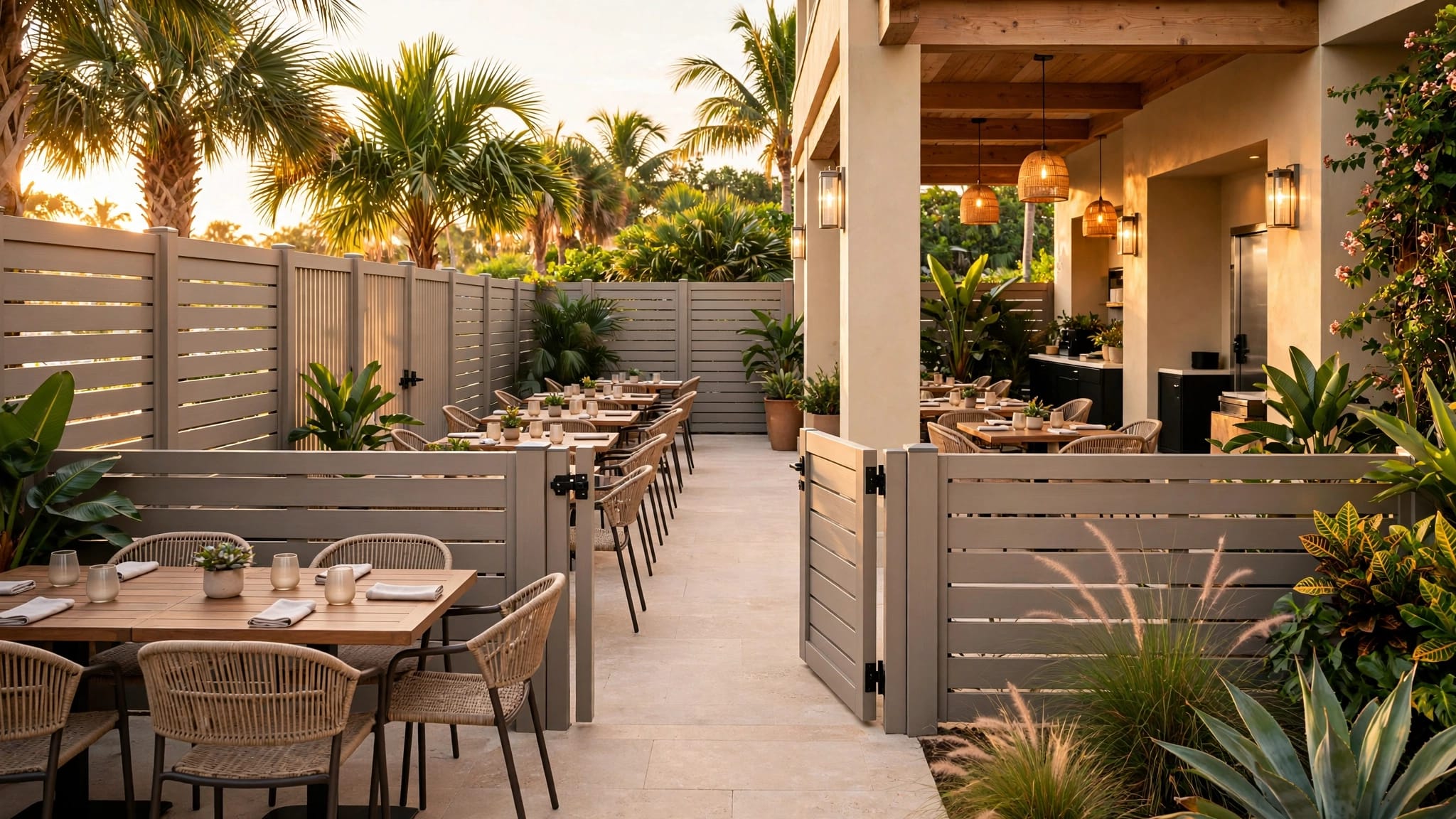
Material affects appearance and upkeep, but panel design determines privacy and airflow . An open aluminum picket fence and a solid aluminum screen behave differently.
Here are the main tradeoffs for a shower enclosure.
| Material | Privacy options | Wet-weather concerns | Routine care |
|---|---|---|---|
| Vinyl/PVC | Solid panels or selected slatted designs | Metal hardware still needs corrosion protection | Mild soap, water, and a soft brush |
| Powder-coated aluminum | Louvers or solid screening | Coating damage and mixed-metal connections | Rinsing and coating touch-ups |
| Wood | Solid boards, overlapping boards, or louvers | Moisture absorption, checking, and decay | Cleaning, finish renewal, and board repairs |
For low-upkeep screening, vinyl and coated aluminum deserve consideration. Wood works well when its appearance justifies a greater maintenance commitment.
Vinyl offers straightforward solid screening
Vinyl doesn't absorb water like wood, and it doesn't need staining. However, shaded surfaces can still collect algae, soap residue, and irrigation stains.
Choose a complete fence system with compatible posts, rails, and gate reinforcement. Solid panels catch wind, so thin panels and weak gate connections undermine an otherwise convenient material.
Our wood and vinyl fence comparison explains their different repair and maintenance demands.
Aluminum and wood suit different priorities
Powder-coated aluminum suits crisp, modern screening. However, ordinary ornamental pickets won't provide shower privacy without a different infill design.
Wood offers flexible board layouts and a warmer appearance. Pressure-treated pine resists decay and insects better than untreated pine, but repeated wetting still requires careful detailing and maintenance.
Balance shower privacy with ventilation
Solid panels provide predictable screening
Solid panels block direct views more reliably than widely spaced slats. They work well on the sides facing neighboring seating or windows.
However, a fully enclosed shower can stay damp longer because less air moves through it. An open top helps, but surrounding walls and dense vegetation can still restrict the breeze.
Light-colored finishes generally absorb less solar heat than dark finishes. Even so, panel color doesn't replace airflow, especially in a narrow space beside the house.
Use solid screening where privacy requires it rather than treating every side identically.
Louvers need the right viewing angle
Louvers offer a useful balance between screening and ventilation. Their performance depends on blade angle, spacing, and the direction people can look through them.
A louvered panel that hides the shower from one patio may expose it from a nearby walkway. Design around all relevant sightlines, including views toward the entrance.
Our guide to louvered fencing for privacy and airflow covers these tradeoffs.
Plants can soften the enclosure's appearance, but keep foliage away from wet panels. Dense growth against the fence limits drying and makes cleaning harder.
Build the enclosure for storms and salt air
Treat posts, corners, and gates as one system
Storm performance depends on the whole installed assembly , including panels, connections, posts, and footings. A panel's advertised rating doesn't describe every possible installation.
Solid screening catches more wind than open fencing. Meanwhile, gates add moving parts and concentrated loads at the hinge post.
Footing design should account for fence height, layout, soil, and exposure. A universal post-depth recommendation won't suit every Southwest Florida yard.
Vinyl gates need suitable internal reinforcement or framing. Aluminum and wood gates also need connections that resist repeated movement without loosening. No material makes an enclosure hurricane-proof.
Protect the connections from coastal corrosion
Aluminum doesn't develop red rust like steel, but it can corrode. Salt deposits, coating damage, trapped water, and incompatible metals increase the risk.
For exposed coastal locations, 316 stainless steel hardware is an option where it suits the specified connection. Aluminum assemblies may also need separation between dissimilar metals.
Powder-coat quality matters, but the hinges and latch deserve equal attention. Our guide to aluminum fence corrosion in salt air explains these weak points.
After salty weather, rinse accessible surfaces with fresh water. Also, repair coating chips promptly and keep irrigation from repeatedly soaking hardware.
Keep shower water and yard drainage in the plan
Fence placement shouldn't interrupt the yard's existing drainage. Heavy rain already tests low spots, so daily shower use shouldn't leave the enclosure surrounded by standing water.
Plan the shower's water-management system separately from the privacy panels. A licensed plumber can address the drainage arrangement safely without relying on assumptions about where shower water may discharge.
Keep posts clear of underground drain lines and maintenance access. Our guidance on fence installation around French drains explains how post locations can conflict with drainage trenches.
The walking surface also needs attention. Choose a surface suited to wet, barefoot use, and avoid depressions where water collects.
For wood fencing, separate boards from persistently wet soil and surfaces. With vinyl or aluminum, preserve the system's drainage openings rather than blocking them with mulch or paving.
Finally, keep access available for cleaning beneath and around the enclosure. A hidden strip that stays wet can become the hardest part of the shower to maintain.
Local fence rules differ across Southwest Florida
A backyard location doesn't automatically permit a tall, solid enclosure. Municipal boundaries, waterfront conditions, easements, and HOA restrictions can change the available layout.
Cape Coral and unincorporated Lee County
Cape Coral's residential fence regulations generally allow a maximum height of 6 feet , or 8 feet where residential property abuts commercial property.
For waterway-abutting properties, fence portions above 3 feet within the rear 20 feet must be open mesh. That restriction can affect where solid privacy screening fits.
Unincorporated Lee County has separate requirements. Its residential fence application calls for two site-plan copies showing property lines, buildings, easements, nearby streets or water, and proposed fencing and gates.
County requirements also place fencing on the owner's property, with the finished side facing adjoining lots or rights-of-way. Along natural water bodies, the code generally requires a 5-foot separation from the mean high-water line.
Fort Myers, Estero, and Bonita Springs
Fort Myers' fence sheet states a 6-foot maximum measured from average ground level. It also places solid-construction fences 20 feet from property lines adjacent to a right-of-way.
Estero's residential application requires two plot-plan copies, with height and setbacks governed by Village zoning.
In Bonita Springs, fencing in the street-side setback area generally has a 3-foot limit. Open-mesh screening may reach 4 feet where vehicle visibility remains clear. Within 25 feet of water, fencing above 3.5 feet must be open mesh.
These are jurisdiction-specific fence provisions. HOA approval is a separate requirement and doesn't replace required permits.
Compare contractor estimates by their complete scope
A small shower enclosure can involve several corners and a reinforced gate despite having little total fence length. As a result, a price per linear foot alone won't explain the project.
The estimate should identify the material, panel layout, height, gate dimensions, and hardware. It should also describe post installation and reinforcement rather than listing only the visible panels.
Include site preparation, removal work, permit handling where required, and cleanup in the comparison. If paving or landscaping forms part of the project, keep those costs separate enough to understand.
We offer vinyl, aluminum, wood, and louvered fencing across Cape Coral, Fort Myers, Estero, and Bonita Springs. For an outdoor shower privacy fence, the useful starting point is a layout showing exposed views, access, and drainage constraints.
Before excavation, utility locating belongs in the installation schedule. Permit and HOA approvals, where required, also belong ahead of construction rather than after materials arrive.
A private shower should stay comfortable and maintainable
A successful enclosure blocks the neighbor's view while allowing the space to dry. Its durability depends on sound connections and placement , as well as the panel material.
Start with sightlines and drainage, then choose the screening style that suits your maintenance preferences. When those decisions fit the property and local requirements, the shower can offer privacy without creating another damp, difficult corner of the backyard.