February 12, 2026
Cape Coral backyards get hit from every angle, summer sun that bakes a lanai, salty air that chews up hardware, and storm winds that test anything tall and flat.
A louvered fence Cape Coral homeowners choose in 2026 is usually about one thing: privacy that still breathes. Think of it like window shutters for your yard. You get a blocked sightline, but you don’t box in hot, stale air the way many solid privacy panels do.
This guide breaks down how louvered fencing behaves in wind and sun, how to set it up for real privacy, and what details keep it comfortable instead of heat-trapping.
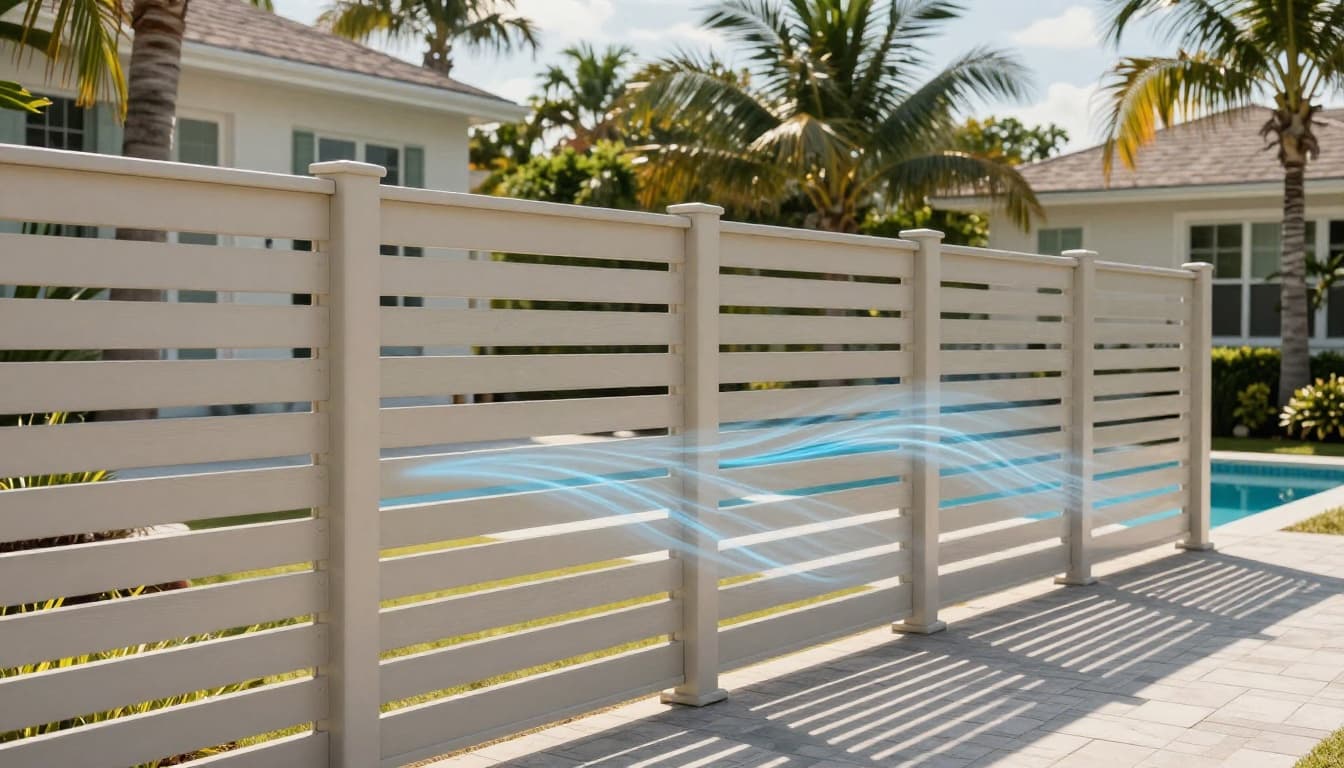 Louvered fencing can block views while still letting breezes move through, this image was created with AI.
Why louvers handle Cape Coral wind better than solid privacy panels
A solid privacy fence is basically a sail. When the wind hits it, there’s nowhere for pressure to go except into the posts, rails, and fasteners. That’s why after big storms you’ll often see full sections leaned over, or a gate post that twisted just enough to keep latching.
Louvers change that equation. Even when they’re “privacy tight,” the geometry creates small pathways that let pressure bleed through instead of slamming into a flat wall. It doesn’t make a fence hurricane-proof, debris is still debris, but it can reduce the all-or-nothing load you get with solid panels.
If you’re comparing styles, here’s the practical way to think about it:
- Solid privacy (vinyl or wood panels) : Best for total visual block, worst for wind pressure.
- Typical slat fence (pickets or horizontal slats with gaps) : Best airflow, weakest privacy unless gaps are small.
- Louvered privacy fence : Middle ground, strong privacy from normal angles, better airflow than solid panels.
Wind performance still comes down to connections. FEMA’s guidance on how wind failures start is a good read because it focuses on the weak links (posts, fasteners, corners), not just materials. See the FEMA Wind Retrofit Guide (P-804) for the bigger picture on wind loads and why anchorage matters.
For Cape Coral homeowners weighing materials, aluminum louvers are popular because they don’t rot, and they handle salt air well when hardware choices are right. If you want to compare coastal durability in plain terms, this local breakdown helps: vinyl vs aluminum fence in Cape Coral hurricanes.
Sun and privacy: louver angles, spacing, and orientation that don’t trap heat
Cape Coral heat isn’t just the temperature, it’s the radiant hit on west and south sides in the afternoon. Solid fences absorb sun, block breezes, and create that “oven corner” along the pavers. Louvers help because they break up direct sun and keep air moving.
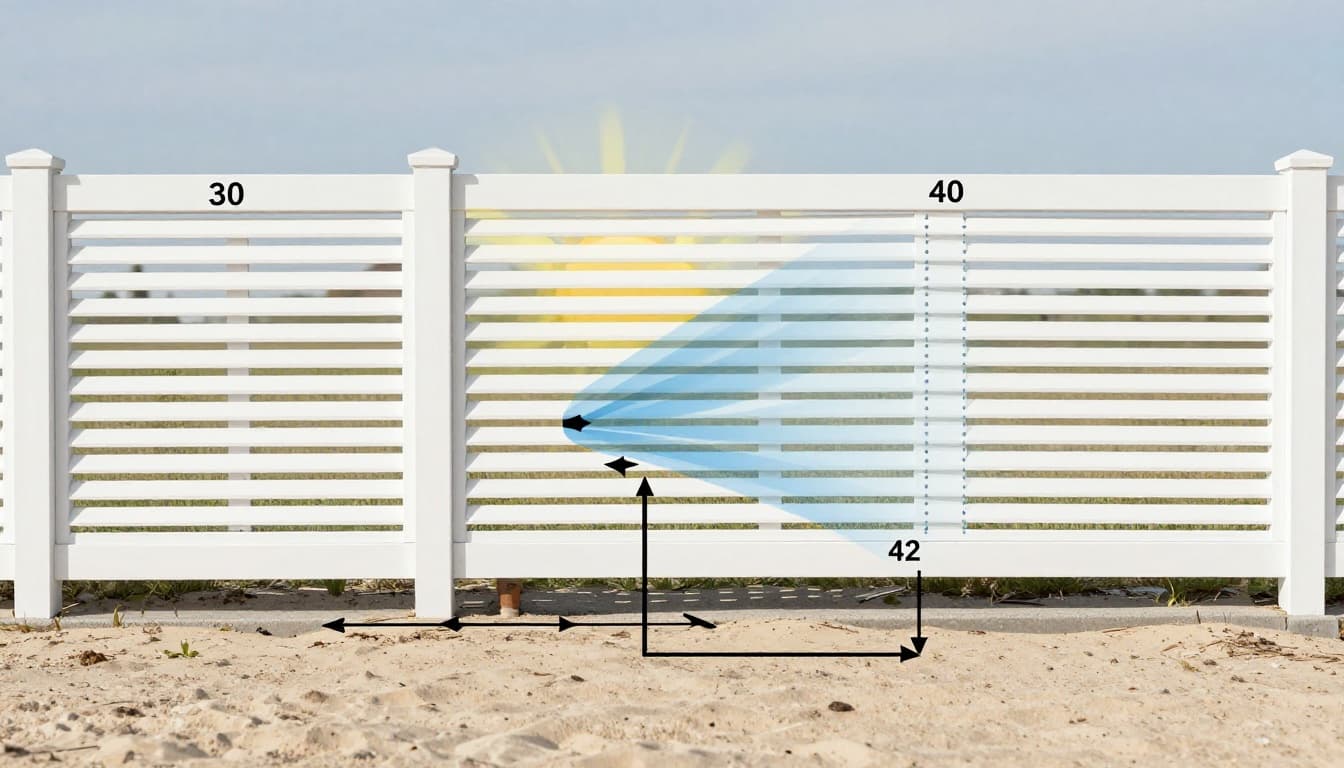 Side angles and spacing control privacy, shade, and airflow, this diagram was created with AI.
Rules of thumb that work in real yards
Fixed vs adjustable louvers
- Choose fixed louvers if you want the least fuss. Fewer moving parts, fewer rattles, and you don’t have to remember to “set” anything before a storm.
- Choose adjustable louvers if your privacy problem changes by time of day (like a neighbor’s second-story window), or if your lanai gets blasted by late sun and you want to tune shade.
Angle ranges (simple and useful)
- Around 30° : more daylight and breeze, privacy is decent from straight-on but weaker at steep angles.
- Around 45° : the sweet spot for most lots, it blocks typical neighbor sightlines and cuts sun while still venting heat.
- Around 60° : maximum privacy and shade, but less airflow. Use it where you’re fighting a hard west sun or a close neighbor.
Spacing and “night privacy” If you want strong privacy at night with lights on inside the yard, don’t rely on wide gaps. As spacing opens up, silhouettes show more easily. Tighten gaps for privacy, then get airflow back with the louver angle and by avoiding solid bottom kick plates that block low-level breezes.
Orientation matters Point the louver “down tilt” toward the side you’re blocking (often toward the neighbor). From your yard, you’ll still feel open, but the view from outside gets shut down.
For heat comfort, color is your friend. Light finishes reflect more sun than dark ones, which is one reason many homeowners prefer powder-coated aluminum in coastal tones. If you’re exploring options, start with aluminum fencing in Cape Coral and ask about louvered-style privacy configurations.
Installation details that decide storm performance (plus permits and HOA reality)
Louver design helps, but installation is what keeps it standing when the gusts stack up. Corners, ends, and gates take the highest stress. That’s where post size, embedment depth, and hardware quality show up fast.
In Cape Coral, permits are not a “maybe.” The city’s own document spells it out and also highlights extra location rules (canals, corners, setbacks). Review the Cape Coral residential fence permit guidelines (PDF) before you commit to a layout. If you’re in unincorporated Lee County, their checklist is helpful too: Lee County Residential Fence Guide (PDF).
Wind loads and structural review tie back to the Florida Building Code and the ASCE wind standards it references. If you want the official code library view, see the Florida Building Code online reference. Your permit reviewer will apply the edition in effect at the time of application, and requirements can vary by exposure and lot conditions.
HOAs add another layer. Many will limit height, color, and “street side” appearance, even if the city would allow it. Always get HOA approval in writing.
Common mistakes that make louvered fences hotter, weaker, or both
- Over-tight spacing everywhere : It can turn a louvered fence back into a wind-catching wall and reduce airflow that keeps the lanai comfortable.
- Wrong tilt direction : Great from inside, useless from the neighbor’s angle. Set the tilt to block the sightline you actually have.
- Not building the gate like a structure : Gates need stronger posts and better hinges because they move, and wind works them hard.
- Insufficient post embedment for height : Shallow posts are the quiet failure that shows up later as leaning runs and misaligned gates.
- Mixed metals in salt air : Pairing dissimilar metals can speed up corrosion. Use compatible, corrosion-resistant hardware and isolate contact points when needed.
If your fence also needs to meet pool barrier rules, don’t guess. Start with a code-focused overview like Cape Coral pool fence requirements, then confirm your exact layout with the city and your inspector.
Conclusion
A louvered fence Cape Coral homeowners install for 2026 can be a smart compromise: real privacy, better airflow than solid panels, and less of that heat-pocket feeling along a sunny fence line. The best results come from matching louver angle and spacing to your sun and neighbor views, then building the posts, corners, and gates like they’re going to see storm season (because they will).
If you’re deciding between louvered, slat, and solid privacy, bring photos of your problem areas, west sun, neighbor windows, and gate locations, and compare designs on paper before anyone digs holes.