February 7, 2026
Cape Coral fences don’t live an easy life. One season you’re dealing with sideways rain and hurricane warnings, the next you’re staring at full sun, salt air, and sprinklers that never miss the same corner post.
If you’re weighing vinyl vs aluminum fence for your home in 2026, the real question isn’t just looks. It’s what happens when wind turns a privacy panel into a sail, or when a gate sags right after a storm because the hinge post wasn’t set right.
This guide breaks down what holds up best in Cape Coral, with the installation details that decide whether a fence stays put or becomes debris.
What actually breaks fences in Cape Coral, Wind pressure, not “bad luck”
In hurricanes, fences usually fail at predictable points: corners, ends, and gates. The material matters, but installation details decide survivability .
A few local realities shape the choice:
- Design wind speeds are high in our part of Florida, and fence loads follow structural wind rules tied to ASCE 7 methods used by the Florida Building Code. The 9th Edition (2026) code cycle is in progress, and enforcement follows the edition in effect at permit time, so it’s smart to confirm what your project will be reviewed under using the Florida Building Code 2026 development page.
- Cape Coral lots often have Exposure C conditions , meaning more open wind flow, especially near canals and wide intersecting streets. More wind gets to your fence with less buffering.
- Debris is the wild card . Even a “wind-friendly” fence can get punched by flying branches. Florida’s hazard guidance emphasizes debris impact and opening protection concepts that apply to yard structures too, see the state Hurricane Retrofit Guide debris impact standards.
- Post and footing work is everything in sandy soils. A beautiful fence with shallow embedment is like an umbrella in a gust, it’s not “if,” it’s “when.”
If you want the big-picture engineering mindset behind wind performance, FEMA’s Wind Retrofit Guide (FEMA P-804) is a solid reference for how wind loads and connections drive failures.
Vinyl fences in hurricanes, privacy comes with a wind “sail” problem
Vinyl is popular for a reason. It looks clean, it won’t rot, and it’s easy to wash. For full backyard privacy, it’s often the first option homeowners consider, see local styles on vinyl fencing in Cape Coral.
The hurricane tradeoff is simple: most vinyl privacy fences are solid panels , so they catch wind like a billboard. That doesn’t mean vinyl can’t work, it means the build has to be planned for wind.
What makes vinyl hold up better in Cape Coral storms:
- Heavier posts (and often steel reinforcement) : Many stronger vinyl systems use a larger post, thicker wall, or a metal insert inside posts (especially hinge and latch posts). This is where “budget vinyl” gets exposed fast.
- Deeper embedment and bigger concrete : In sandy soils, shallow footers let posts lean, then rails pop out. For 6-foot privacy, deeper post holes (often in the 42 to 48-inch range, depending on layout and soil) with adequate concrete mass are common hurricane-minded practices.
- Tighter spacing and smarter layouts : Longer panel spans increase deflection. Corners, returns, and “long straight runs” need extra attention because they rack under gusts.
- Fasteners that don’t quit : Stainless or hot-dipped galvanized hardware helps in salt air. Vinyl systems still rely on metal fasteners at gates, latches, and sometimes brackets.
- Gate frames that act like structures : Vinyl gates should have a metal frame or internal reinforcement. Otherwise they sag, bind, and start tearing hardware out of posts after wind loading.
Bottom line: vinyl is best when you truly need privacy, and you’re willing to invest in beefier posts, proper footings, and reinforced gates. Otherwise, the same privacy that feels great on a calm day can be the fence’s weak point in a hurricane.
Aluminum fences in hurricanes, a “wind-through” design that helps
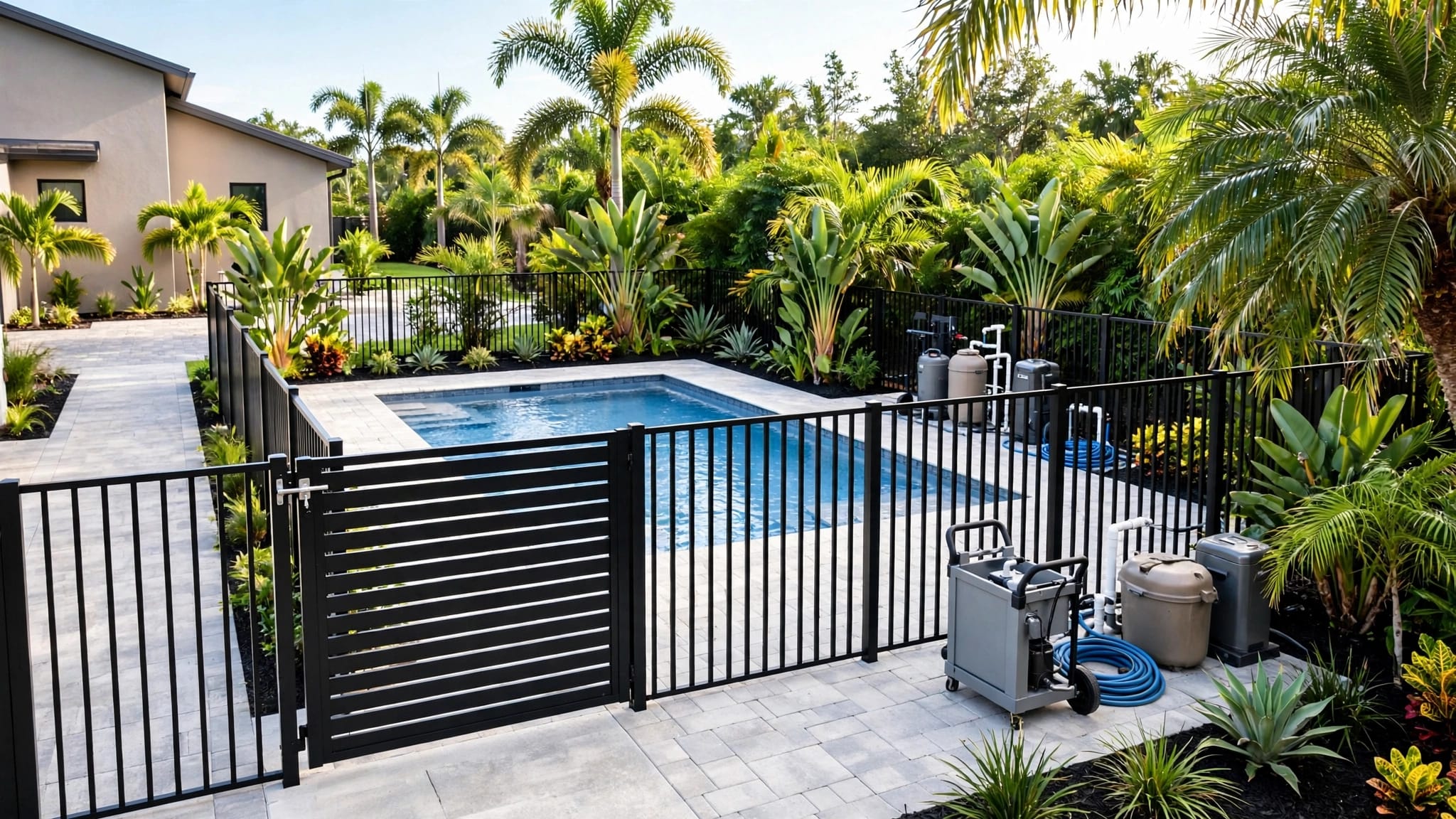
Aluminum fencing is a different animal. Most aluminum styles are picket fences, so wind passes through instead of pushing on a solid wall. That one design difference is why aluminum often looks better after a major blow.
If you’re considering an ornamental or pool-style fence, start with aluminum fencing in Cape Coral and then focus on the structural choices.
What makes aluminum a strong hurricane fit:
- Rackable panels for slopes and settlement : Cape Coral yards aren’t mountainous, but drainage swales and slight grade changes are common. Rackable panels reduce stress points that can loosen over time.
- Post size and wall thickness : Aluminum systems vary a lot. The stronger installs use heavier posts at corners and gate openings (and sometimes upgrade line posts too). Thin posts are where you’ll see wobble first.
- Better gate survivability (when framed right) : A welded aluminum gate frame with a diagonal brace and quality hinges usually survives better than a hollow vinyl gate. The hinge post still needs proper depth and concrete.
- Corrosion resistance is a real advantage near canals : Aluminum does not rust, and powder coating adds another layer of protection. The main risk is at scratches, cut ends, and mixed-metal contact , so stainless hardware and touch-up habits matter.
The downside is privacy. Aluminum won’t block views or noise unless you add slats or landscaping. But if your top priority is “still standing after the next storm,” aluminum’s wind-through design is hard to beat.
Vinyl vs. aluminum fence, a simple Cape Coral comparison (2026)
Here’s a straightforward way to compare typical residential-grade options in Southwest Florida.
| Category | Vinyl fence (privacy) | Aluminum fence (picket/ornamental) |
|---|---|---|
| Wind resilience | Fair to Good (depends heavily on reinforcement) | Good to Excellent (wind passes through) |
| UV/sun resistance | Excellent (quality vinyl resists fading) | Good (powder coat holds up well) |
| Salt/corrosion | Good (won’t rust) | Excellent (best long-term in salt air) |
| Privacy | Excellent | Fair |
| Maintenance | Low | Low |
| Repair speed after a storm | Fair (panel sections can be fussy) | Good (replace a panel or picket section) |
| Expected lifespan | Good (often 20+ years with quality materials) | Excellent (often 20+ years with quality coating) |
| Typical cost range in SWFL | $25 to $45 per linear foot installed | $25 to $40 per linear foot installed |
Costs move with height, gates, demo, access, and how much reinforcement the job needs. For a local pricing breakdown, see fence installation costs in Cape Coral.
Post-storm checks and local FAQs (permits, pool code, HOA limits)
After a hurricane or tropical storm, a 10-minute walk can prevent a month of headaches.
Vinyl post-storm inspection steps
- Check for leaning posts first, especially corners and gate posts.
- Look for rails that popped loose from routed posts.
- Inspect panels for cracks at the bottom edge (debris hits often show there).
- Test gates for sag, latch misalignment, and hinge pull-out .
- If your system uses reinforcement, check for rust staining around fastener points.
Aluminum post-storm inspection steps
- Sight down the fence line for racking (panels out of square).
- Check brackets and screws for loosening at posts.
- Inspect gate swing and latch, look for hinge-side post movement .
- Look for chips or scratches in the powder coat and touch up to protect the finish.
- Confirm bottom clearance stayed consistent (soil washout can change grade).
FAQ for Cape Coral homeowners
- Do I need a permit to install or replace a fence?
Often, yes. Start with the city’s forms in the Cape Coral Permit Document Center and confirm county guidance on when a permit is required. - Where can I check fence height and placement rules?
Cape Coral’s land development rules are published online, see the Cape Coral Land Development Code viewer. Your HOA can be stricter than the city, so check both. - What about pool fence requirements?
Pool barriers have extra rules for height, gaps, and self-closing gates. A practical local overview is in this Cape Coral pool fence requirements guide. - I live on a canal, which material is safer long-term?
Aluminum usually wins for salt exposure, as long as hardware is corrosion-resistant and coating damage is addressed quickly. Vinyl won’t rust, but the wind load on privacy styles is the bigger hurricane concern.
Practical recommendation for 2026
For most Cape Coral homes, aluminum is the safer bet for hurricanes , because it sheds wind pressure instead of fighting it. Choose vinyl when privacy is non-negotiable, but only if you’re committing to stronger posts, deeper footings, and reinforced gates. Either way, the best upgrade isn’t the material, it’s the build, especially the posts, concrete, and hardware that keep everything connected when the wind shows up.